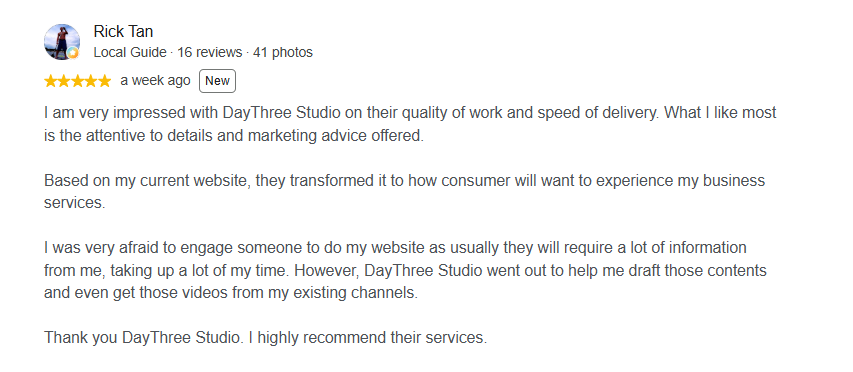
The objection was never the design
Rick was not worried about how the site would look. He was worried about what it would cost him in time. He had hired for this kind of thing before and expected the same shape: weeks of being chased for copy he had never written down, decisions he did not have opinions about, and a project that stalls on his side and then gets blamed on his side.
He had the business in his head and none of it on paper. That is normal, and it is the web designer’s problem to solve, not the client’s.
A thirty-minute chat became the words
One call. I asked what each audience actually wants, what people ask him before they book, and what he finds himself repeating. That recording became the copy for all five pages, which he then read and corrected rather than wrote. Correcting is fast. Writing from nothing is what kills these projects.
The footage was the same story. He had years of aerial video already sitting on his own channels, so the hero and the showreel came from material he had shot himself. Nothing was commissioned and nothing was stock.
Each audience gets its own page, and its own form
A business looking for aerial footage and a hobbyist looking for a weekend course have nothing in common except the person selling to them, so they never see each other’s pitch. Courses, filming and experiences each got their own page with its own enquiry form, plus a general form on the home page for people who do not know what they want yet.
Every form carries a hidden field recording which page it came from. Rick can see which page produced an enquiry instead of guessing, which is the only way to eventually find out where the marketing money should go. On the general form, the first question is simply what would you like to do, which sorts the undecided before he ever picks up the phone.
He edits it himself
Prices change, intakes change, a course gets renamed. Rather than have that come back to me every time, the site was built so that every visible word lives in one content file, with a private editor behind a password: a form on the left, his live site previewing on the right, and a Publish button that puts it online in about a minute. This was the first site I built that way. It has since become how I build all of them.
Nothing was lost when the domain moved
Before the domain moved across, his existing WordPress site was archived and kept reachable at a spare address. Domain cutovers are the one step in a build that is genuinely hard to undo, and the safe version costs an afternoon.